
FirstLook Team
· 13 min read
Most studios treat playtesting as the moment they find bugs. That is the smallest part of what it is for. A playtest is the first time real players meet your game, and if you run it well, it is also where you build the community that carries your launch, learn how players actually feel, and turn strangers into the people who buy on day one and tell their friends.
This is a guide to how to playtest a game with all of that in mind. Not just “does it crash,” but who to invite, how to get them talking, how to read their sentiment honestly, how to reward the ones who show up, and how to know whether the whole thing is working. Run it this way and a playtest stops being a QA task and becomes the engine of your launch.
Playtest vs closed beta vs open beta: what actually differs#
Before we get into the tactics, it’s worth being clear on what you’re running, because the four common formats are often used interchangeably even though they answer very different questions.
| Format | Who’s in | What it’s for | When to run it |
|---|---|---|---|
| Internal playtest | Team, family, friends | Sanity check on the core loop | Any time. Weekly is normal for indie teams. |
| Closed playtest | Handpicked or invite-only players | Deep feedback from your core audience | 6-12 months before launch, in cycles |
| Closed beta | Larger cohort of qualified signups | Stress test, balance, retention data | 3-6 months before launch |
| Open beta / demo | Anyone with a Steam key or demo | Marketing moment, wishlist velocity, launch-day converts | 1-3 months before launch, often tied to a showcase |
The rest of this guide is mainly about closed and open playtests, because that’s where community, sentiment, and referral loops start compounding into launch momentum.
Start with a trailer: where to premiere it, and what it costs 🎬#
Before anyone can test your game, they have to hear about it, and nothing tops a trailer for that. Think of it as the top of your playtest funnel. Where you premiere it decides how many of the right people show up.
There is a wide spread of options, from free to genuinely eye-watering:
- Digital showcases (mostly free). Events like Day of the Devs, Wholesome Direct, the Guerrilla Collective and Future Games Show are free to apply to and curated, which means rejection is normal. Apply to as many as fit your game, and do it four to six months ahead with a polished trailer and demo. A slot puts you in front of tens of thousands of primed viewers at no media cost. Our full directory of indie game festivals and showcases covers 30+ events across every category.
- Steam Next Fest (free). Your demo plus a trailer during Steam Next Fest is the single biggest free wishlist moment on the calendar, and it feeds directly into a playtest audience. It runs in February, June, and October each year.
- Media premieres (earned, sometimes paid). An exclusive reveal on IGN or GameSpot’s YouTube channel can drive a huge wishlist spike, and it is usually earned by pitching a genuinely strong trailer through PR rather than paying a listed fee. Paid placement packages exist, but prices are negotiated and rarely published. If you want a firm to handle the pitch, see our directory of games marketing agencies and PR firms.
- The very top end. For scale: trailers at The Game Awards have been reported to cost up to $450,000 for 60 seconds and around $1 million for three minutes, though some large publishers get editorial placements for free. This is not where most studios should be looking.
A quick note on the old guard: GameTrailers, once the default destination, is no longer the force it was, and the premiere landscape has moved to showcases, YouTube reveals and creator channels.
The trailer itself ranges just as widely, from a few hundred pounds on a freelance marketplace to a $10,000-plus cinematic production. For most studios the winning play is not a seven-figure slot. It is a good trailer, a smart PR pitch to IGN-style channels, and a fistful of free showcase applications.
Recruit players and find your core audience 🎯#
A trailer brings a crowd. Your job now is to pull the right people out of it. The single most common playtesting mistake is chasing volume: 2,000 random signups will teach you less than 200 players who actually love your genre.
Your core audience is the group whose expectations your game is built to meet. Find them where they already gather: your Steam Coming Soon page, genre-specific subreddits and Discords, communities around similar games, and creators whose audience matches your tags. A demo is the best filter of all, because the players who finish it are self-selecting into your core.
This is the part FirstLook was built for. You can recruit and onboard playtesters in one click, pull qualified players from the player network, and funnel signups straight from your store page and player.gg into one place. If you want a deeper tactical breakdown, our guide on how to find more playtesters goes further on the channels that actually work.
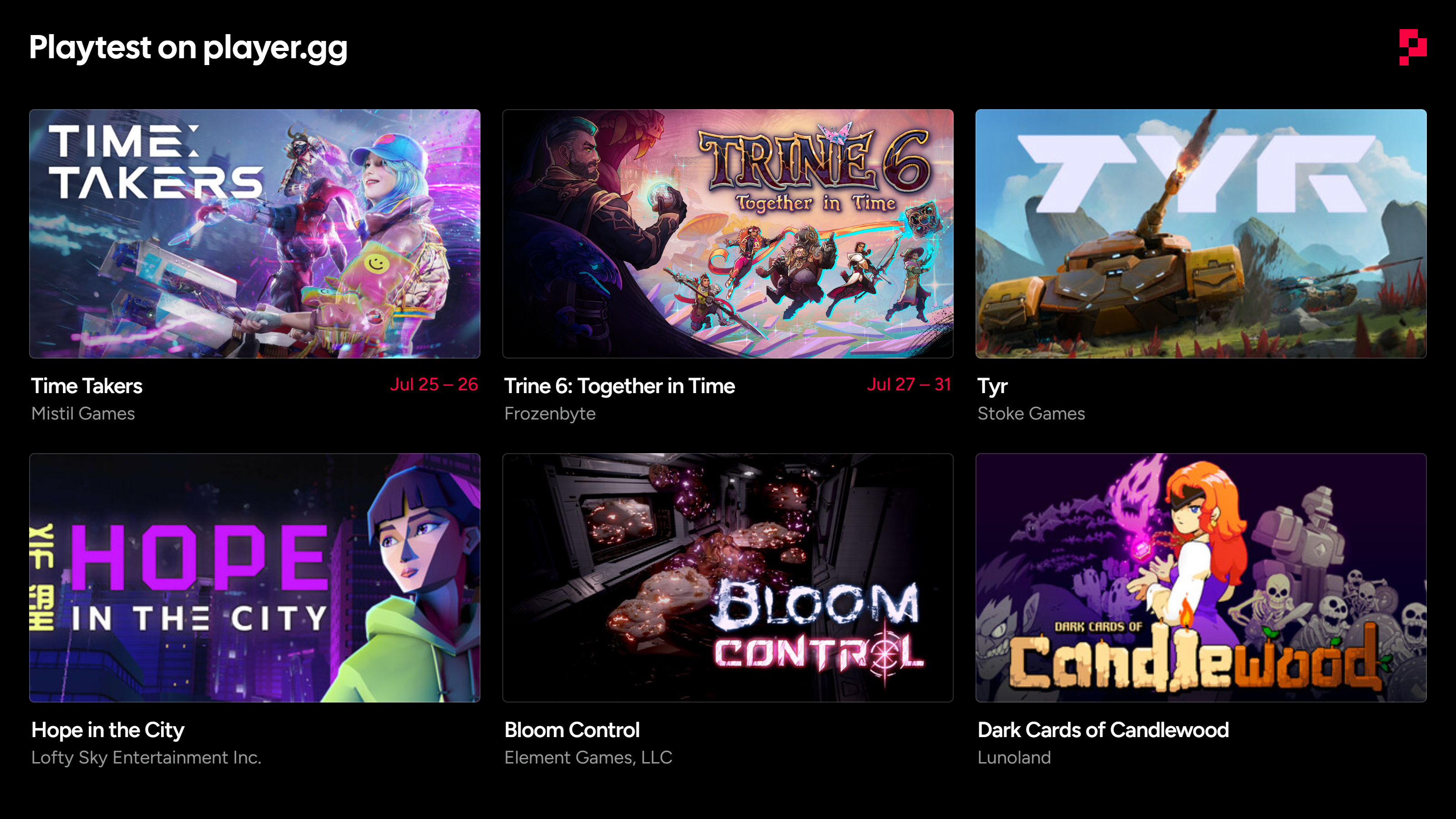 Playtests running on player.gg surface directly to a network of pre-qualified players by genre, tag and past behaviour.
Aim for a tight core first, then widen. A few hundred genre-fit testers who keep coming back are worth more than a stadium of people who bounce after five minutes.
Get players to invite their friends 🔁#
The cheapest, highest-quality growth you have is your existing testers bringing people they know. A recommendation from a friend converts far better than any ad, and it compounds: every tester who invites two more turns a small pool into a wave.
Build the loop on purpose rather than hoping it happens:
- Give each tester a referral link or a couple of “bring a friend” keys.
- Make inviting worth it (more on rewards below), and make it a single tap, not a form.
- If your game has any co-op or multiplayer, lean into it. Friends who test together stay together, and they recruit each other for you.
- Even in single-player, design one shareable moment, the thing a player screenshots or clips, and give them an easy path to pull a friend in when they hit it.
Track who is actually driving invites so you can reward your best connectors. A handful of enthusiastic testers usually account for most of the referral growth, and knowing who they are is worth real money at launch.
Why Discord is your playtest headquarters 💬#
You can collect feedback through forms, but a relationship needs a room. Discord is where your testers already are, it is real-time, and it turns a one-way survey into a two-way community that sticks around all the way to launch.
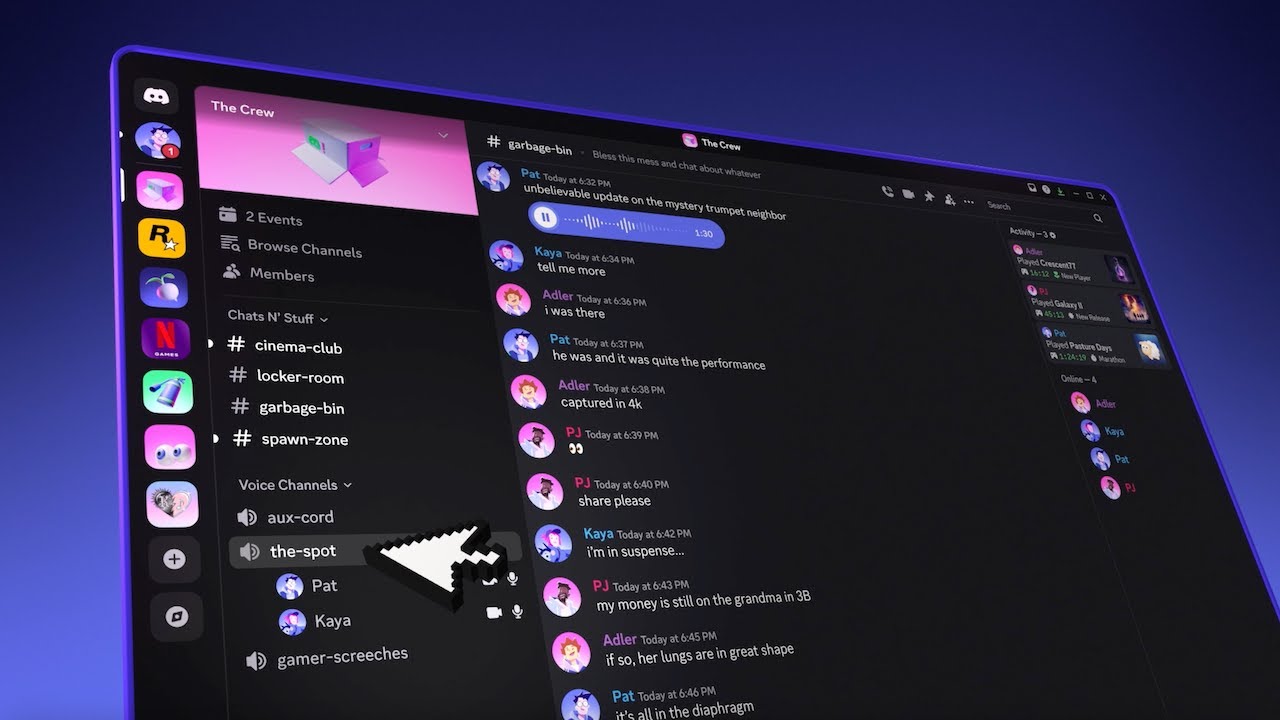 A healthy playtest Discord looks like this: side chatter, in-jokes, and channels split for feedback, bug reports, and general community.
Set the server up so it works from the first minute:
- A clear onboarding flow so new testers know exactly where to go and what to do.
- Dedicated channels for feedback, bug reports and build announcements, kept separate from general chat.
- Roles that recognise testers, and later, separate access for creators and VIPs.
- A predictable rhythm of updates and reasons to show up, so the server does not go quiet between builds.
The failure mode is a dead server, and it usually comes from weak onboarding and no cadence. Treat those two things as seriously as the game build. Keeping a player CRM alongside your Discord means you actually know who your most active members are, instead of watching an anonymous member count tick up while engagement quietly falls.
For a deeper look at why Discord signals matter beyond a member count, see Signals of Success Part 3: Discord.
Capture sentiment: surveys and feedback channels 📊#
Bugs are the easy signal. Sentiment, how players actually feel, is the one that decides whether they will buy and recommend, and it takes a little more care to read.
Collect it in two forms. The unstructured stream is your Discord channels and bug reports, where you catch the language players use and the problems you did not think to ask about. The structured stream is surveys, which give you numbers you can compare over time.
Keep surveys short and pointed. A handful of questions beats a wall of them:
- Would you recommend this to a friend, and why (your clearest early read on word of mouth).
- What frustrated you most, and where did you stop playing.
- Would you buy this at launch, and at what price.
Run a quick in-build or post-session survey while the experience is fresh, and always close the loop by telling players what you changed because of their feedback. Nothing retains a tester like seeing their note turn into a patch. Track sentiment as a trend across builds, not a single snapshot, so you can see whether your changes are landing.
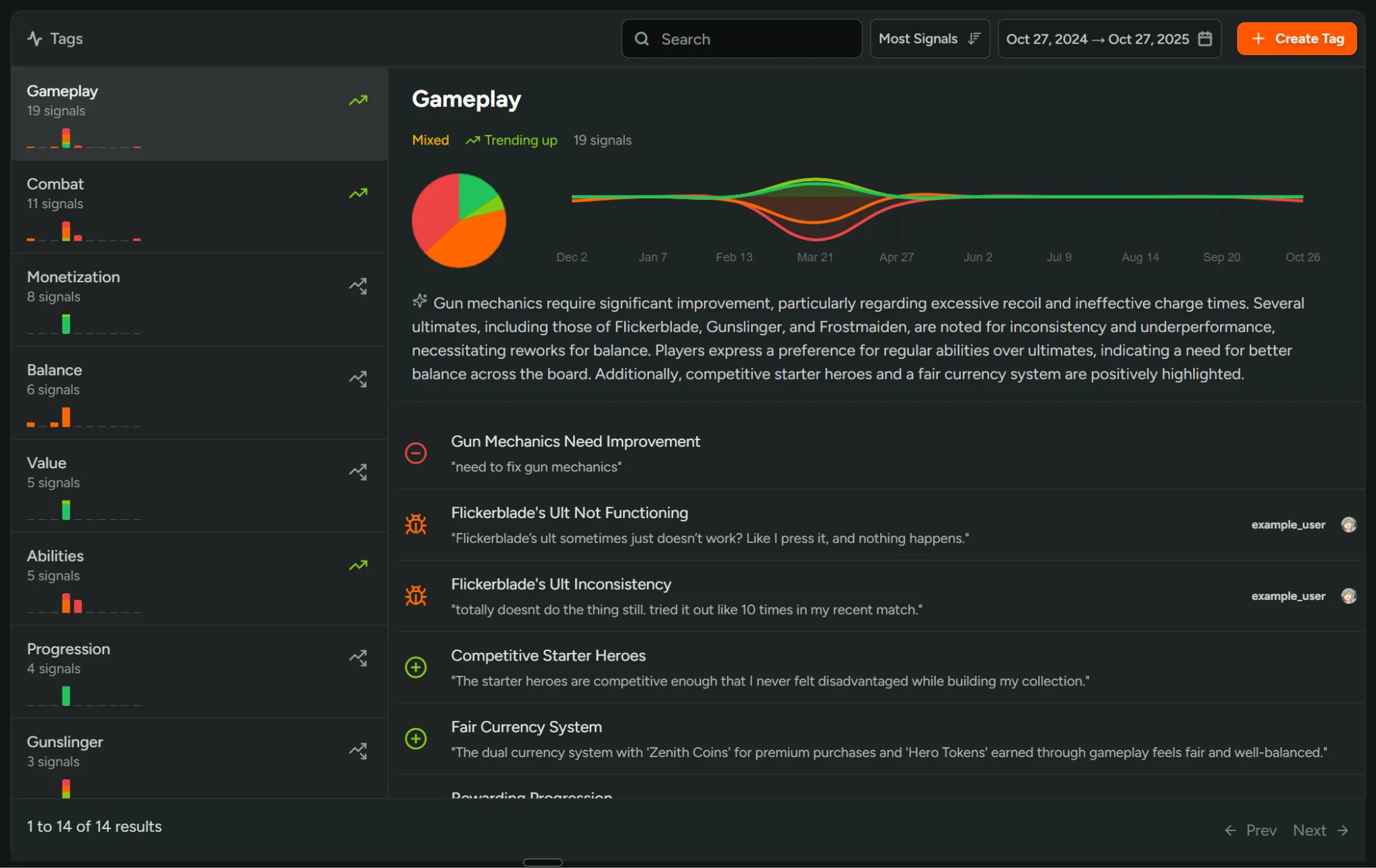 FirstLook auto-tags player feedback into themes like gameplay, balance, and monetisation, so sentiment becomes a trend you can steer by rather than a wall of unread messages.
FirstLook pulls surveys, feedback and analytics into one engagement view, and with FirstLook Agent you can ask questions of your player data directly instead of hand-sorting hundreds of responses. For the wider signals framework, Part 5 of Signals of Success covers how social chatter fits in alongside playtest sentiment.
Reward feedback and referrals 🎁#
People show up for a game they love, but they show up more, and more often, when their effort is recognised. A rewards system turns goodwill into a habit.
Reward two behaviours specifically: quality feedback and successful invites. The rewards themselves do not need to be expensive:
- Steam keys, in-game cosmetics, or credits.
- Discord roles and badges that mark someone as a founding tester or top contributor. Status is a shockingly powerful reward and it costs you nothing.
- Early access to new builds, leaderboards for most bugs found, or a spot in the credits.
One firm rule: reward participation and quality, never positivity. Do not tie rewards to good reviews or glowing feedback, both because it poisons your data and because paying for reviews breaks Steam’s rules. You want honesty, and you want the players who give it to feel seen. Managing who earned what, and which roles they hold, is far easier when your rewards and your player records live in the same system rather than a spreadsheet you update by hand.
Onboard creators with a VIP Discord 🌟#
Creators are not just bigger testers. They are a distribution channel, and they deserve their own lane. Give them a separate, private space, a VIP channel or server, where they get treated like the partners they are.
That VIP space should hand creators everything they need to cover you without friction: early builds, keys, clear embargo dates, ready-to-use assets, and a direct line to your team. The easier you make it to make content, the more content you get.
Pick for fit over follower count. A creator whose audience is exactly your genre will out-convert a much larger channel that is a loose match, every time. FirstLook’s creator tools let you onboard creators, distribute keys securely, and run these campaigns alongside the rest of your playtest, so your community and your creators are managed in one place rather than two disconnected worlds. Our post on game content creator management goes deeper on running creator programmes end-to-end.
What does good look like? The metrics that matter 📈#
Signup count is a vanity metric. It feels like progress and tells you almost nothing. Here are the numbers that actually say whether your playtest is working:
- Activation rate: the share of signups who install and actually play. If this is low, your problem is onboarding, not the game.
- Engagement: session length, sessions per tester, and above all return rate, the share who came back after day one.
- Survey response rate: if you cannot get testers to answer a three-question survey, your community is colder than the headcount suggests.
- Sentiment: your would-recommend score, tracked build over build.
- Referral rate: invites sent per tester, and the share of new testers coming from existing ones.
- Communicator rate: the percentage of members who actually post, give feedback or talk. A big community where almost nobody communicates is a warning sign hiding behind a good-looking number.
- Wishlist conversion: the share of testers who wishlist, which is your bridge from playtest to launch-day sales.
You do not need perfect benchmarks to start. Watch these as trends across cohorts, and push each one up build by build. FirstLook surfaces this kind of data on dashboards so you are steering by the metrics that predict a launch, not the ones that just flatter it. Studios from indie to AAA use it to scale a tester base into a launch-day audience.
Put it all in one place 🚀#
Run this well and a playtest does everything at once: it hardens the game, builds your community, reads real sentiment, grows through referrals, warms up creators, and converts into wishlists. The catch is that doing it across Steam, Discord, survey tools and spreadsheets is a full-time job on its own.
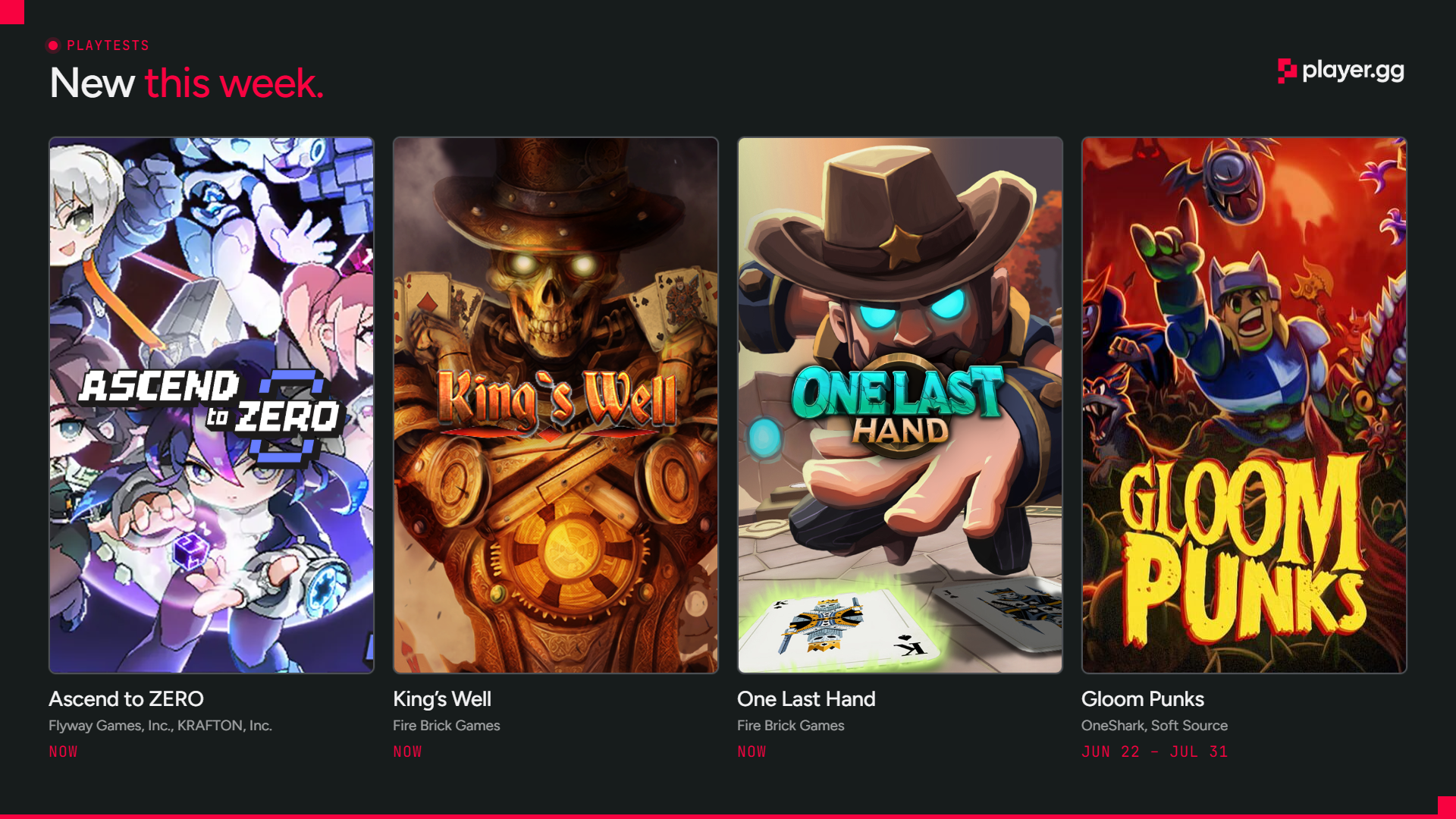 Studios launching playtests on FirstLook and player.gg get discovered by a pre-qualified network of players rather than having to build the pipeline from scratch every time.
That is the whole reason FirstLook exists. Recruit and onboard players, gather Discord-native feedback, run surveys, reward your contributors, onboard creators, and watch the metrics that matter, all in one loop instead of six tabs.
Ready to run a playtest that actually builds your launch? Get started free on FirstLook.
FAQ#
How many players do I need for a good playtest?#
Fewer than you think. A tight closed playtest of 100-300 genre-fit testers who actually return build over build gives you far better data than 2,000 signups who churn on day one. For a launch-focused open beta or demo tied to Steam Next Fest, you want thousands, but that’s a marketing moment more than a learning moment.
How long should a playtest last?#
For closed cycles, 2-4 weeks per build tends to be the sweet spot. Long enough to see real behaviour and return patterns, short enough to keep testers engaged before you ship a new build for them to react to. For open betas around a launch window, one to two weeks with a hard end date creates urgency and drives wishlist conversion.
What’s the difference between a closed beta and a playtest?#
Terminology varies by studio. In practice, a playtest is usually invite-only, curated, and about learning; a closed beta is a larger, stress-test cohort focused on stability, balance, and retention data at scale. An open beta or demo is public and mostly a marketing moment. All three can share the same infrastructure.
Should I run playtests on Steam or somewhere else?#
Both. Steam Playtest is powerful because it links testers directly to your store page (feeding wishlists), but it doesn’t handle community, survey, or reward workflows well. Most serious playtest ops pair Steam Playtest with a dedicated platform for onboarding, sentiment, and rewards, plus Discord for community.
How do I stop my Discord from going quiet between builds?#
The two failure modes are weak onboarding and no cadence. Fix the first with a clear “start here” flow and role assignments in the first 60 seconds after a new tester joins. Fix the second by shipping regular content, not just builds: dev diaries, tester spotlights, community events, and quick polls. A predictable rhythm keeps the room warm even when there’s no new build.
Can I reward testers for giving feedback?#
Yes, but reward the participation, not the sentiment. Steam keys, cosmetics, credits, roles, and status are all fair game. What you cannot do is reward positive reviews, glowing feedback, or wishlisting itself, both because it poisons your signal and because it violates Steam’s storefront rules.
When should I run a playtest before launch?#
Start earlier than you think. Six to twelve months out is normal for closed cycles that inform design decisions. Three to six months out is when open betas and demos start to double as marketing. The last four weeks before launch are for stress tests and wishlist velocity, not learning.