
FirstLook Team
· 4 min read
In Part 1 we explored why playtest sign-ups are one of the strongest early indicators of player purchasing intent. In Part 2 we broke down how retention reveals depth, showing who stays, who drifts, and why. In Part 3 we examined how Discord is critical because it’s where your players actually live and converse.
Now we turn to the fourth critical signal: media and press coverage.
Our recent study of 250+ senior gaming professionals found that a staggering 93% of studios are influenced by pre-launch metrics that don’t accurately predict a game’s success. As development costs rise and player acquisition gets fiercely competitive, studios can’t afford to build in isolation. Tracking early media interactions gives you a vital snapshot of the market your game will launch into, and proof of whether audiences grasp the core value before you commit fully to production, marketing, or launch.
Tracking media coverage throughout a game’s lifecycle also helps show whether audiences are excited by, confused by, or frustrated with new updates, so you can iterate in real time and protect player retention.
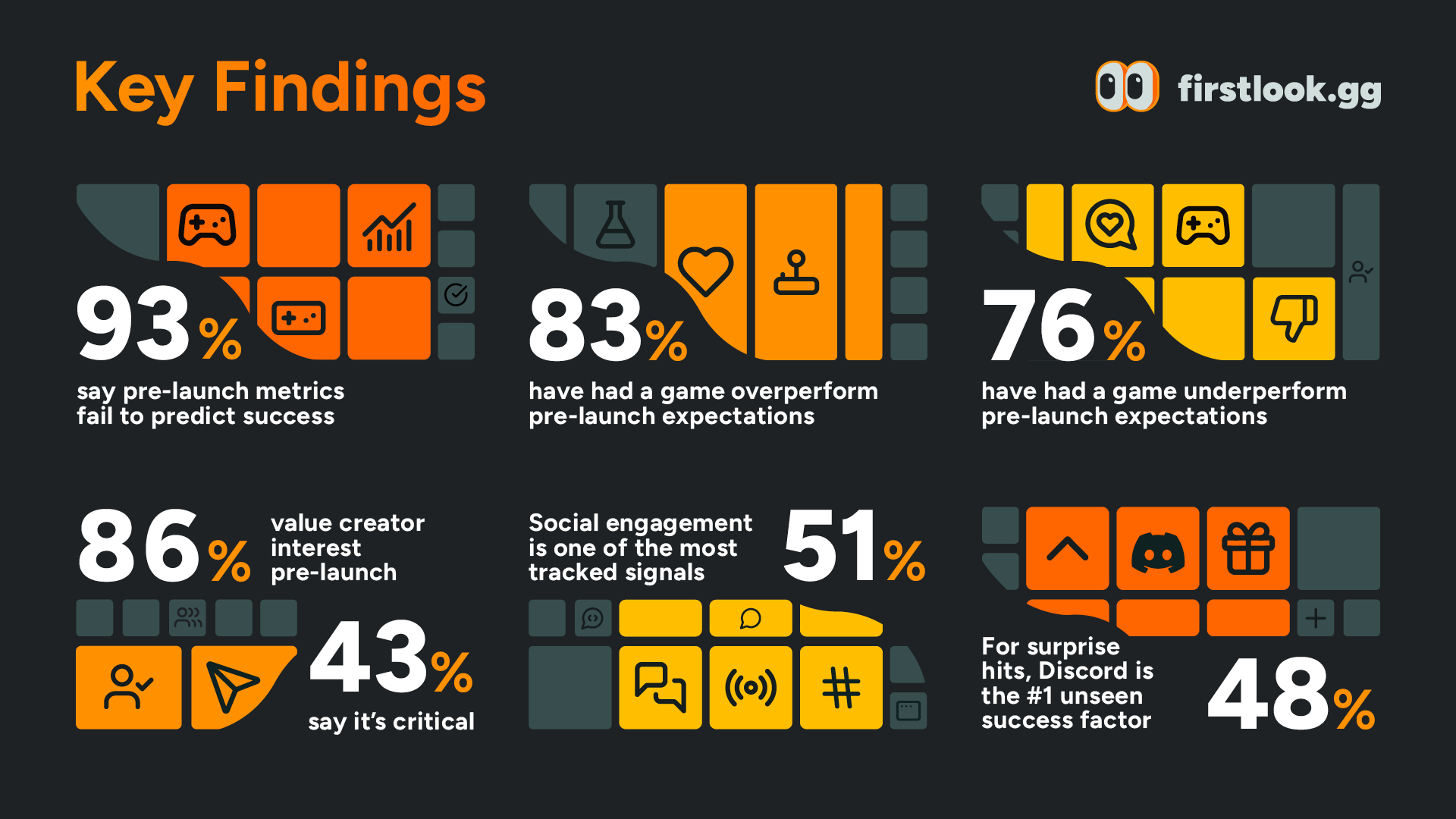 From the FirstLook 2026 study of 250+ senior gaming professionals.
Why media coverage matters#
As the industry shifts toward long-term engagement, tracking media sentiment across a game’s lifecycle becomes essential. Long before launch, games journalists act as a barometer for your positioning.
When your game releases new content, feature updates, or patches, how the media reacts is a key signal of whether those changes will positively or negatively affect player interest.
If journalists struggle to explain your core loop or a new feature, that usually means your target audience will face the same confusion. When press coverage mirrors your development goals, that’s proof your core message is clear, sharp, and repeatable. Evaluating this feedback lets studios shift from a reactive position to an anticipatory one, using data-backed insights to make sure their strategy is being received the way they intended.
What to measure#
To use media and press coverage as an actionable signal, studios should track four core metrics.
1. Volume of organic coverage#
Organic pickup demonstrates genuine market interest. When journalists proactively cover your playtests or new content without being paid to, it proves your concept stands out in a crowded attention economy.
2. Media sentiment#
To secure high-quality insights, match the volume of coverage with clear ideas on media sentiment. Track whether articles land as positive, neutral, skeptical, or confused.
Check the context of the coverage, not just the count. Writers offering deep analysis or critique are deeply engaged. Persistent confusion, on the other hand, highlights where promises you made about the game might be mismatched with the in-game reality.
3. Reader reactions#
Beyond the journalists themselves, monitoring comments, sharing, and community discussion reveals how deeply readers are investing emotionally. Check how much readers are engaging with a journalist’s opinion or the media coverage itself. Modern audiences expect active influence and participation, not passive consumption. Reader engagement is a solid signal that an active community is forming around the coverage.
4. Key message pickup#
Measuring how accurately journalists repeat your unique selling points validates your positioning. Market alignment happens when media language reflects your internal design intent, confirming that the market (at least from a media perspective) agrees with the narrative you’re trying to establish.
How to interpret the signals#
Evaluating media coverage delivers the most value when you correlate it directly with other metrics.
When a major preview drops alongside a simultaneous spike in positive Discord activity or extended play session lengths, you can see that media coverage has successfully converted broad awareness into authentic engagement. That alignment validates that a new update, feature, or press release matches your actual player experience.
FirstLook turns sentiment into strategy, helping you de-risk development by listening to the story your data is telling.
The value of media coverage#
For game developers, media coverage acts as an early test of market understanding, message resonance, and organic audience interest. Reading the patterns in the data behind that coverage enables studios to turn editorial and public sentiment into a clear market signal. That, in turn, informs design choices and changes with the confidence that they’ll improve both the player experience and commercial performance.
If you’re not sure where to start on the coverage side itself, our directory of games marketing agencies and PR firms for indie studios is a good place to explore who to work with.
Get started with FirstLook#
Ready to stop chasing false signals and build with certainty? As an all-in-one Player Relationship Platform, FirstLook unifies your player insight and engagement data across the full product lifecycle.
- For indie studios, FirstLook emphasises speed and creative momentum, removing friction from development operations so smaller teams can collaborate with players effectively.
- For larger studios, FirstLook delivers operational confidence, offering the consolidated infrastructure to listen, learn, and extract structured intelligence from a large, distributed player base.
Understanding your community and the player connection is what helps predict which games actually succeed. Contact us today to monitor the signals that matter.